
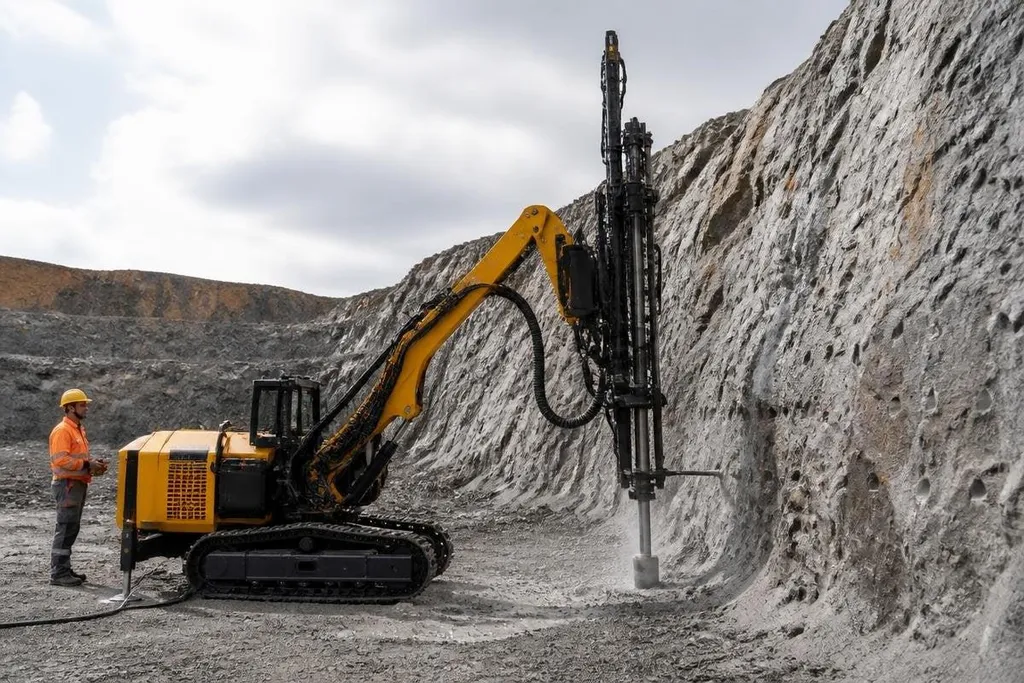
A robotic drilling rig can position a drill, control feed force, and stop when sensors detect a change in the material. That shifts drilling from constant manual adjustment toward a process that software can repeat, record, and check.
If you're assessing the technology for a mine, construction site, or energy project, the useful question is where that control improves the work and where a person still needs to make the call.
- The main gain: repeatable hole placement and drill motion
- The main limit: changing rock or soil can defeat fixed settings
- The buying test: compare setup time, remote operation, safety, and maintenance
What the robot controls
A robotic drilling system usually combines a drill rig with sensors, motor controls, and software. The system can move the drill along planned axes, set a feed rate, control rotation, and record values such as torque, vibration, and penetration speed.
Those readings help the system react to the material. If torque rises, the controller can slow the feed or stop the drill. If penetration changes, the software can record the change for later review. The exact response depends on the machine and its control system.
This matters because drilling quality depends on repeatable motion. A hole that starts in the wrong place can affect blasting, anchoring, sampling, or the next stage of work. Software cannot remove every source of error, but it can reduce variation in the movements it controls.
Why companies are testing it
Drilling puts people near rotating tools, heavy structures, dust, noise, and unstable ground. Remote operation can move the operator away from the drill face or work zone. A camera and sensor feed can then give the operator information without placing them beside the machine.
Automation can also keep a record of each hole. That record may include the planned position, drilling time, depth, torque, and other machine readings. A supervisor can use it to check the work and find changes between holes instead of relying on memory or handwritten notes.
Repeatable control helps when a task follows the same pattern for many holes. It helps less when the machine must respond to conditions that the software has not seen. Rock, soil, broken ground, water, and tool wear can all change the drilling response.
A drilling report needs the rig, rock type, hole depth, tool, and test date. Robotic drilling reports from Robot24.com can tie those details to claims about machine control, so you can compare a controlled test with work underground.
Where autonomy stops
A drilling robot can follow a plan, but the plan still needs good input. The site team must define safe work zones, confirm the target location, choose a suitable tool, and set limits for force, speed, and depth.
Sensors also have limits. Dust can affect cameras. Vibration can make readings harder to interpret. A worn bit can change the load on the drill. Software may detect those changes without knowing whether the cause is hard rock, a damaged tool, or a problem with the rig.
That is why remote supervision remains part of many robotic drilling designs. An operator can pause the machine, review the sensor data, inspect the work area, and change the plan when conditions fall outside the expected range.
The machine handles repeatable movement; a person handles uncertain conditions.
I'd judge a drilling robot by how well it handles a change in the material, not by how smoothly it repeats a fixed demo.
A practical buying checklist
Before comparing systems, ask the supplier to show how the machine works on your task and what happens when conditions change.
- Define the hole pattern, depth, diameter, and required placement accuracy.
- Check which readings the system records and how you can export them.
- Test remote operation with the cameras, controls, and network used at the site.
- Ask how the system reacts to tool wear, high torque, lost sensor data, and an emergency stop.
- Price the people, training, software, spare parts, and service needed after installation.
The last point often changes the business case. A machine may reduce time beside the drill while adding work in setup, data review, software support, or tool changes. Those tasks belong in the comparison from the start.
What comes next
The next useful proof will come from repeated work in changing ground. A system that keeps hole placement within the required limit, records why it stops, and lets an operator recover safely has a practical case; a smooth fixed-condition demo does not answer that question.